Table of Contents
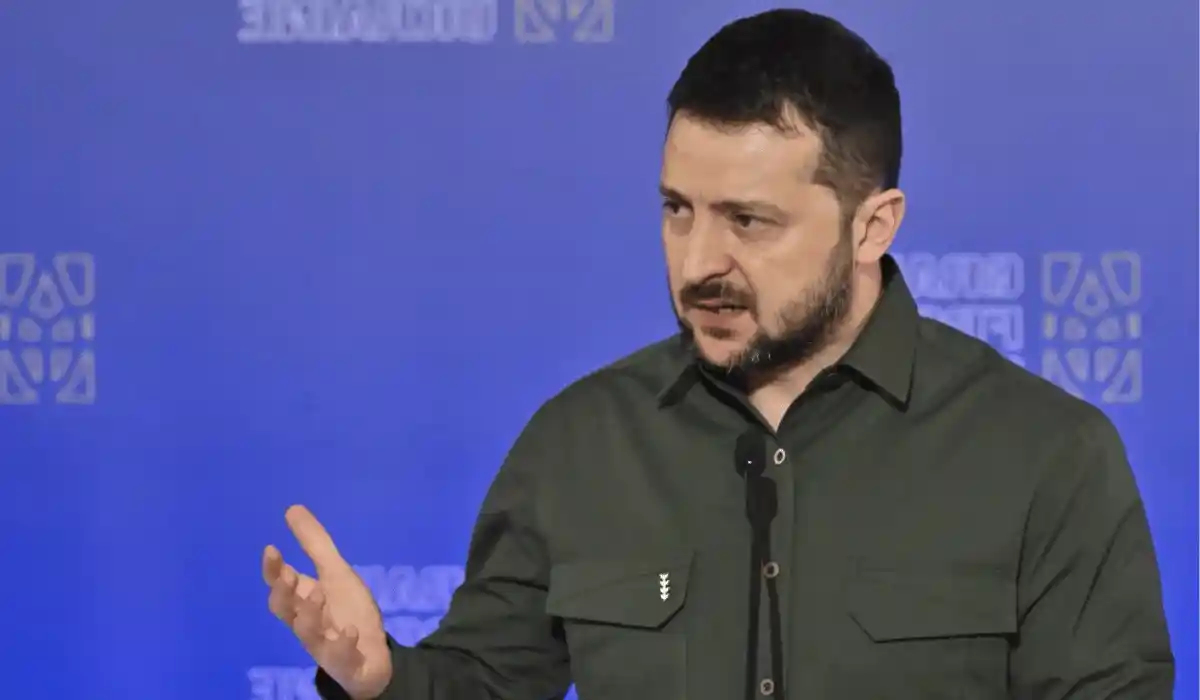
Volodymyr Zelensky just showed his hand in a way nobody quite expected. The Ukrainian president sat down with reporters Tuesday and laid out some serious concessions on issues that could have easily derailed any peace talks with Moscow. Now Russia has to decide what to do with it.
What made this meeting stand out was how open Zelensky was about everything. He walked through details of a 20-point plan, calling it “a foundational document on ending the war, a political document between us, America, Europe, and the Russians.” He went deep into what security guarantees might actually look like between Ukraine, the US, and European partners, the kind of specifics that would need to anchor any real deal with Russia.
Zelensky said he’s waiting for Moscow’s response, which he expected to come Wednesday after the Americans talk things through with the Kremlin.
The Territory Question
This draft agreement is actually a streamlined version of an earlier 28-point plan the US had already floated to the Russian side. The big reveal came when Zelensky explained what Ukraine could live with regarding troop withdrawals from parts of the Donetsk region in eastern Ukraine that aren’t currently under Russian control.
We’re talking about strategically vital territory here. Places like Kramatorsk and Sloviansk, these heavily fortified Ukrainian cities that form what’s essentially a fortress belt in Donetsk. They’re what stands between Russian forces and any deeper push into Ukraine’s heartland. Putin has been adamant that Ukraine needs to basically hand over all of Donetsk for peace to happen.
But Zelensky’s proposal introduces something different. Russia would need to pull back its forces by the same distance that Ukrainian troops retreat, creating what amounts to a demilitarized buffer zone along portions of the current front lines.
“If we establish a free economic zone here, and it envisages a virtually demilitarized zone, meaning heavy forces are removed from this area, and the distance, for example, is 40 kilometers (it could be five, 10, or 40 kilometers), then if these two cities, Kramatorsk and Sloviansk, are our free economic zone, the Russians would have to pull back their troops accordingly by five, 10, or 40 kilometers,” Zelensky explained.
What’s Actually in the Plan
The draft covers a lot of ground beyond just troop movements. Here’s what Zelensky outlined, including some revisions Kyiv has proposed:
- Sovereignty and Non-Aggression: Ukraine wants an affirmation of its sovereignty paired with a non-aggression pact between the two countries.
- Security Guarantees: This is the crucial component. The US, NATO, and European states would provide guarantees that Zelensky said would “mirror Article 5,” that bedrock NATO principle where an attack on one is treated as an attack on all. The idea is that if Russia invades Ukraine again, there’d be a military response and sanctions would snap back into place. But here’s the catch: those guarantees would vanish if Ukraine attacks Russia or fires on Russian territory without being provoked first.
- Economic Recovery Package: Zelensky talked about a development package to help Ukraine’s postwar economic recovery, including a Ukraine Development Fund focused on technology, data centers, and artificial intelligence. He also mentioned getting US companies involved in Ukraine’s natural gas sector. He put the war’s total economic damage at around $800 billion.
- Zaporizhzhia Nuclear Plant: One particularly interesting wrinkle involves the Zaporizhzhia nuclear power plant, which Russia currently holds. Zelensky’s compromise proposal suggests a joint US-Ukrainian enterprise would run it, with half the electricity going to Ukraine and the US deciding what happens with the rest.
- Russian Troop Withdrawals: The plan calls for Russian troops to withdraw completely from the Dnipropetrovsk, Mykolaiv, Sumy, and Kharkiv regions.
- Implementation and Monitoring: Everything would be locked into a legally binding agreement, with implementation overseen by a Peace Council that US President Donald Trump would chair.
- Immediate Ceasefire: Crucially, there’d be an immediate full ceasefire the moment all parties sign on.
The Referendum Question
Territory control remains the trickiest piece of this puzzle, along with figuring out the order in which everything happens. Zelensky spent considerable time discussing a potential nationwide referendum in Ukraine that would formalize the war’s end.
“People could then choose: does this ending suit us, or does it not?” he said. “That would be the referendum. A referendum requires at least 60 days. And we need a real ceasefire for 60 days; otherwise, we cannot hold it. In other words, the referendum would not be legitimate.”
People living under Russian control, he pointed out, can’t reasonably be expected to vote freely.
“But in the territory we control, where a legal and fair referendum can actually be conducted, the voting and preparation process, just as, by the way, with the potential elections our partners talk about, must take place under secure conditions,” he said. “Without security, legitimacy is in question as well. We explain all of this to our partners.”
The Election Pressure
There’s been mounting pressure on Ukraine to hold elections quickly once any agreement gets signed. Putin has consistently argued that Kyiv’s government lacks legitimacy and that Ukraine must hold elections for peace to work. Zelensky’s presidential term technically expired in 2024, but elections can’t happen under the martial law that’s been in effect since Russia’s full-scale invasion. The Ukrainian parliament has repeatedly upheld those wartime measures.
Where Things Stand
The Trump administration’s peace push, spearheaded by US special envoy Steve Witkoff and Jared Kushner, Trump’s son-in-law, has been making slow but steady progress lately. This past weekend, a Ukrainian delegation led by National Security Secretary Rustem Umerov and Kremlin envoy Kirill Dmitriev had separate meetings with their American counterparts. Witkoff called the talks “constructive and productive.”
On Wednesday, Kremlin spokesman Dmitry Peskov told reporters on a conference call that Dmitriev gave Putin “a detailed briefing on the results of his trip to Miami. Based on this information, Moscow will formulate its next steps and continue contacts in the very near future through existing channels.”
Peskov wouldn’t get into specifics, saying Moscow thought it was “counterproductive” to hash out negotiations through the press.