
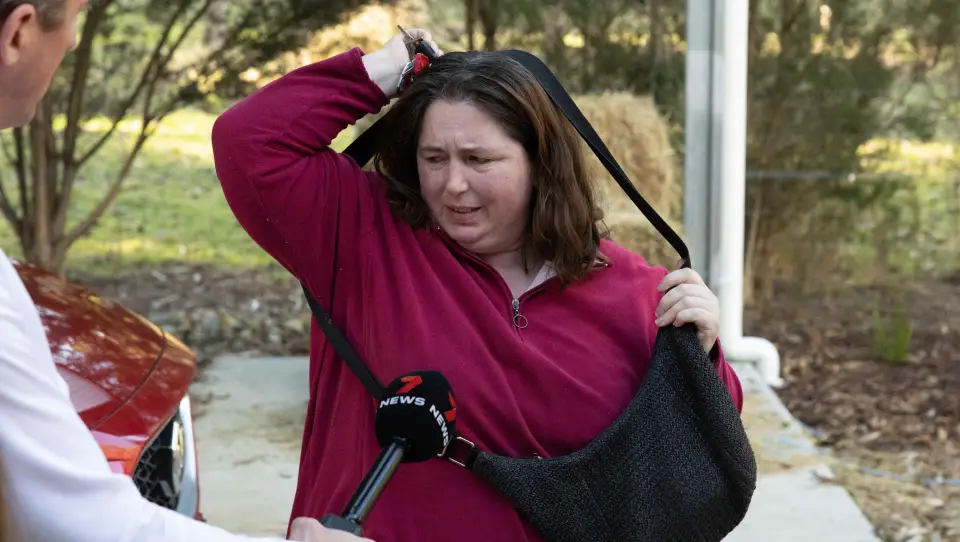
After nearly two years and a nine-week trial, a jury has found Erin Patterson guilty in the murder and attempted murder of her estranged husband’s elderly relatives, three of whom died after eating her home-cooked meal containing poisonous mushrooms.
The 50-year-old mother of two is facing life in prison over the events of July 2023 and will be sentenced later.
That summer, Patterson hosted four guests — her husband’s parents, aunt and uncle — for lunch at her home in the small town of Leongatha, about 85 miles from Melbourne.
It is undisputed that she served them individual portions of home-made beef Wellington, a steak dish wrapped in pastry, usually with a paste of finely chopped mushrooms. And, as Patterson herself testified during the trial, that paste contained death cap mushrooms, which are among the most poisonous in the world.
All four guests were hospitalized with gastrointestinal symptoms the following day, and three of them died the following week from altered liver function and multiple organ failure due to Amanita mushroom poisoning. The sole survivor recovered after weeks in intensive care and went on to testify at Patterson’s trial in Victoria state Supreme Court.
The trial — which lasted far longer than its expected six weeks — featured over 50 witnesses, eight days of Patterson’s testimony and a series of twists and turns.
The main question facing the jury: Did Patterson knowingly put death cap mushrooms in the dish with the intention of killing her guests?
Prosecutors argued that she did so on purpose, citing financial tensions between her and her estranged husband but stopping short of offering a motive. Patterson, who pleaded not guilty to three counts of murder and one count of attempted murder, denied that the poisonings were deliberate.
Throughout the trial, Patterson’s lawyers argued that some foraged mushrooms made it into the dish by accident, and said she later covered up her actions — including lying to investigators about things like foraging for mushrooms, owning a food dehydrator and becoming ill herself after the meal — out of fear after her guests’ deaths.
In the days before the jury members entered sequestered deliberations, Justice Christopher Beale warned that Patterson’s lies did not inherently prove her guilt.
“Even if you think that the alleged incriminating conduct she admits engaging in makes her look guilty, that does not necessarily mean that she is guilty,” he said.
But the jury was convinced of her guilt.
A recap of the case
Patterson has been married to her husband, Simon, since 2007, but the two separated permanently in 2015 after multiple splits and reconciliations. In testimony, the couple — who share custody of their two kids — spoke about having an amicable relationship that deteriorated in the winter of 2022 over issues related to child support payments.
Then, in July 2023, Patterson invited Simon and several of his relatives over for lunch: his parents, Gail and Donald Patterson, both 70, as well as Gail’s sister, Heather Wilkinson, 66, and Heather’s husband Ian Wilkinson, 68 — the sole survivor.
Patterson told the group that she wanted to discuss a medical issue she was having and whether to tell her kids, who were not present during the meal. After Simon pulled out the night before, she expressed her disappointment in a text, writing: “I wanted it to be a special meal, as I may not be able to host a lunch like this again for some time.”
Wilkinson later testified that Patterson told the guests at lunch that she had been diagnosed with cancer.
The prosecution said medical records showed no such diagnosis, and accused Patterson of lying as a pretense for the adults-only meal. Patterson admitted from the stand that “I didn’t have a legitimate medical reason,” and said she was too embarrassed to tell her guests she was actually considering weight-loss surgery.
By that point, the family had finished their meal. Patterson had made each of the guests their own individual beef Wellington pastry, and served herself on a plate that was a different size and color than the other four. That quirk was observed not only by Wilkinson but his late wife, Heather, who mentioned it to Simon Patterson when he took her to the hospital the following day.
The two couples started to feel sick that night, experiencing dozens of episodes of vomiting and diarrhea even after being hospitalized the next morning. They were initially able to share their experiences and medical histories with doctors, who grew increasingly concerned that they weren’t experiencing just gastroenteritis.
Toxicologists determined that their symptoms were indicative of “serious toxin syndrome caused by ingestion of amanita phalloides mushrooms,” also known as death cap mushrooms.
The patients weren’t immediately given the antidote because there wasn’t enough evidence to confirm they had ingested such mushrooms. Despite receiving other forms of treatment — including an emergency liver transplant, in one case — their conditions continued to deteriorate.
Heather Wilkinson and Gail Patterson died on Aug. 4, and Donald Patterson died the following day. Ian Wilkinson was extubated on Aug. 14 and discharged to rehabilitation on Sept. 11.
During the trial, much time and scrutiny was given to Erin Patterson’s behavior after her guests fell sick and died.
For instance, there was much back and forth over whether Patterson ever got sick herself. Patterson said she experienced diarrhea for several days starting within hours of the lunch, though her exact accounts varied.
Prosecutors, citing medical records and doctors’ testimonies, argued she wasn’t experiencing any symptoms of mushroom poisoning and consistently resisted hospital care. Patterson’s lawyers alleged that she simply didn’t eat enough of the dish to get as sick as the others. By way of explanation, Patterson testified that she threw up later that day after eating the rest of the cake that one of her guests had brought.
Patterson also acknowledged she did not tell authorities about the possibility of death cap mushrooms being in the dish even as her guests lay in the hospital, instead telling them that she had used a mix of mushrooms: fresh from a local chain and dried from an unspecified Asian grocery store.
When police asked her whether she had ever foraged for mushrooms, she said no — which she and her defense lawyers also acknowledged was a lie. She also lied about having a food dehydrator, which she had purchased months before the lunch and quickly disposed of after the deaths.
On the stand, Patterson said she had dumped the dehydrator out of panic as the tragic implications of her meal became clear, calling it “this stupid, knee-jerk reaction to just dig deeper and keep lying.” Her team maintained that she had a good relationship with her in-laws, and no reason to hurt them.
Simon Patterson was the prosecution’s first witness in the trial, and was questioned extensively about their relationship. Erin Patterson later testified — and Simon denied — that during a conversation with her husband in the hospital following the lunch, the topic of her dehydrator came up and he asked: “Is that how you poisoned my parents?”
Prosecutors also accused Patterson of trying to cover her tracks in other ways, such as doing a factory reset of her phone during the police investigation. They later found photos in her camera of wild mushrooms being weighed on the dehydrator tray in her kitchen.
Patterson testified that she cleared the phone because “I knew that there were photos in there of mushrooms and the dehydrator and I just panicked and didn’t want [detectives] to see them.”