
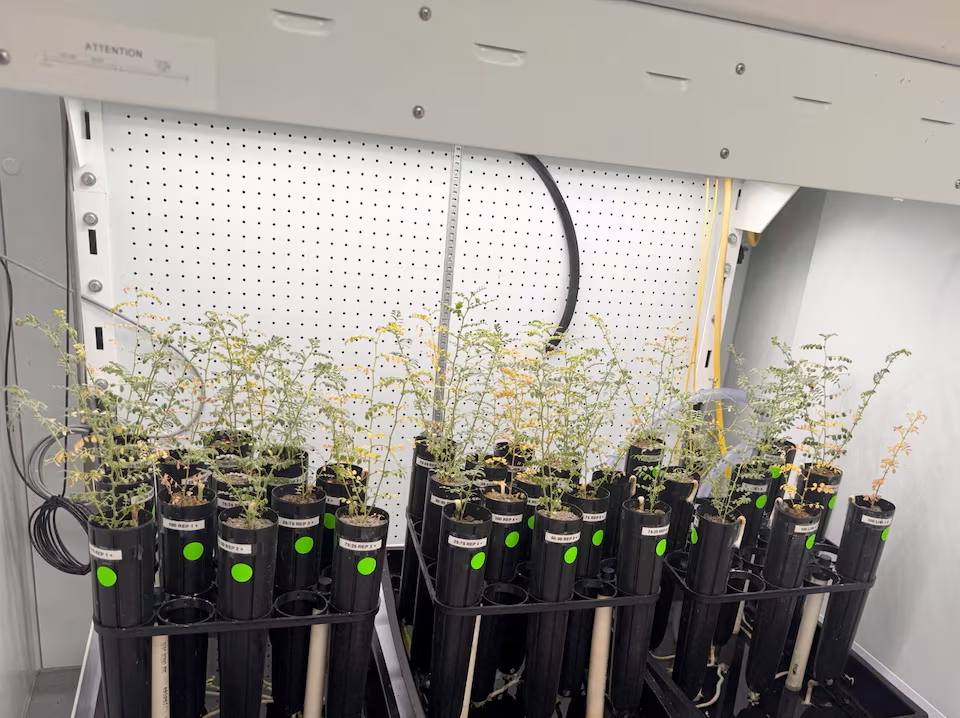
Scientists working on the future of space farming have taken a step closer to making food production possible on the moon. In a recent experiment, researchers successfully grew chickpeas in soil mixtures largely made from simulated lunar soil, showing that astronauts on long-term lunar missions might one day be able to grow their own food.
The team cultivated chickpeas in soil designed to mimic lunar dirt collected during Apollo missions more than 50 years ago. The soil simulant was combined with vermicompost — a nutrient-rich material produced when earthworms break down organic waste — to support plant growth.
The experiment was conducted at Texas A&M University in a climate-controlled growth chamber. Researchers used a chickpea variety called “Myles,” coating the seeds with beneficial fungi before planting them in mixtures containing simulated lunar soil produced by Space Resource Technologies.
The plants were able to produce harvestable chickpeas in soil mixtures containing up to 75% lunar simulant. However, as the proportion of simulated moon soil — known as regolith — increased, the number of chickpeas produced declined. While the size of the chickpeas remained stable, seeds planted in 100% regolith failed to flower or produce seeds and died early.

Both the United States and China plan to return astronauts to the moon in the coming years with the goal of eventually establishing long-term lunar bases. Growing food locally will be crucial for sustaining astronauts during such missions.
“Chickpeas are high in protein and other essential nutrients, making them a strong candidate for space crop production,” said Jessica Atkin, a doctoral candidate and NASA fellow at Texas A&M’s Department of Soil and Crop Sciences, lead author of the research published on Thursday in the journal Scientific Reports.
Having a local food supply is considered essential for supporting crews living on the moon because transporting large amounts of food from Earth would be impractical and extremely costly.
“In our goal toward establishing a lunar presence – or one on Mars – we will need to learn how to grow food on the moon, since it will not be sustainable to ship food in spaceships. This is because it is still quite expensive to ship things to space, so weight is a factor, and also because the survival of astronauts on the moon can’t be dependent on the timely shipment of supplies,” said study co-author Sara Oliveira Santos, a postdoctoral researcher at the University of Texas Institute for Geophysics.
“Plants would also help produce oxygen and enhance life-support systems for future human settlements,” said astrobiologist Jyothi Basapathi Raghavendra of Northumbria University in England, lead author of a second study published on Thursday examining how microbes grow in simulated Martian soil.
Lunar soil is very different from Earth soil. It consists mainly of crushed rock and fine dust created by billions of years of meteorite impacts. The particles are often sharp and glass-like. While the material contains certain minerals and nutrients needed for plant growth, it lacks the organic matter that makes Earth soil fertile.
“Previous studies have shown plants can germinate in authentic lunar samples or grow in regolith simulants, often by adding compost or other types of organic matter,” Atkin said. “In this study, we focused on microorganisms. Instead of only adding organic material, we tested whether plant-microbe partnerships could help condition regolith, improve its structure and reduce plant stress.”
How Do They Taste?
The obvious question remains: what do moon-grown chickpeas taste like? For now, scientists do not have an answer.
“The chickpeas are currently being tested for metal accumulation, which is why we haven’t eaten them just yet,” Atkin said.
Both lunar regolith and the soil simulant used in the experiment contain high levels of metals such as aluminum and iron. While iron is an essential nutrient for plants, aluminum can be toxic if consumed in large quantities.
“Before anyone makes moon hummus, we need to confirm they are safe and nutritious. Those results will be published in a follow-up paper later this year,” Atkin said.
The fungi used to coat the seeds played an important role in the experiment. These microorganisms formed a symbiotic relationship with the chickpea plants, helping them absorb key nutrients while reducing the uptake of heavy metals. They also helped bind the loose particles of regolith together, making it behave more like natural soil on Earth.
Researchers even added a bit of fun to the experiment. Atkin played lunar-themed songs in the lab, including Bad Moon Rising by Creedence Clearwater Revival, hoping to inspire the plants. She also placed a picture in the lab showing chickpeas growing on the moon.
“Kind of silly, but something to aim for,” Atkin said.
“This is a small first step toward growing crops on the moon,” Oliveira Santos said, “but we have shown this is feasible and we are moving in the right direction.”