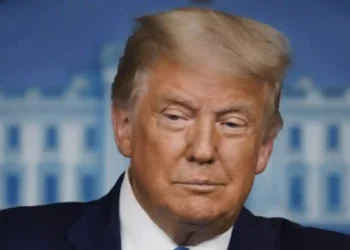
The SAVE America Act has become a central priority for President Donald Trump, who has repeatedly highlighted it in Oval Office briefings, campaign-style rallies, and posts on his Truth Social platform.
This week, the Senate is expected to begin an extended debate on the elections bill. The legislation would require individuals to provide proof of U.S. citizenship when registering to vote and present photo identification when casting a ballot.
Trump, Republican hardliners, and conservative voices such as Elon Musk are urging the Senate to pass the bill, which cleared the House in February. However, Democrats strongly oppose the proposal, and voting rights organizations warn that it could disenfranchise millions of voters.
Here’s a closer look at what the bill includes, who it may impact, and why it has sparked significant controversy:
Who opposes the bill and why?
Most Democrats and voting rights groups argue that the legislation could prevent millions from voting due to stricter citizenship and photo ID requirements.
According to the Brennan Center for Justice and the University of Maryland’s Center for Democracy and Civic Engagement, around 21 million Americans do not have immediate access to documents proving their citizenship, while 2.6 million lack any form of government-issued photo ID. Low-income and minority voters are more likely to face difficulties meeting these requirements. Additionally, individuals who have changed their last names — particularly married women — could encounter added challenges during registration.
Democrats also claim the SAVE America Act is part of a broader effort by Trump to influence the outcome of the 2026 midterm elections, which will determine control of Congress and shape the final two years of his presidency.
Why is Trump focused on the SAVE America Act?
For years, Trump has raised concerns about noncitizen voting and has repeatedly claimed — without evidence — that U.S. elections are insecure. In recent months, he has intensified these claims ahead of the 2026 midterms, warning that he could face a third impeachment if Democrats regain control of Congress.
He has also suggested measures such as nationalizing elections, enforcing voter ID laws, and banning mail-in voting through executive action.
“The Save America Act is one of the most IMPORTANT & CONSEQUENTIAL pieces of legislation in the history of Congress, and America itself. NO MORE RIGGED ELECTIONS! Voter I.D., Proof of Citizenship, No Rigged Mail-In Voting (We are the only Country in the World that allows this!),” the president wrote in a Truth Social post on Tuesday.
Are we the only country that allows mail-in voting?
No. While many countries limit mail-in voting, more than two dozen nations allow some form of postal voting, according to the International Institute for Democracy and Electoral Assistance. Countries such as Canada, the United Kingdom, and Germany all have systems in place for mail-in ballots.
Do voters already need ID to vote or register?
Voting requirements vary by state. The National Conference of State Legislatures reports that 36 states either require or request voters to show identification at the polls, with 10 states enforcing strict photo ID laws.
Meanwhile, 14 states and Washington, D.C., do not require ID for voting. Instead, they verify voter identity through other means, such as signature matching.
Registration rules also differ, but a 2002 federal law requires first-time voters who register by mail and have not yet verified their identity to do so before voting. Acceptable documents include photo ID, bank statements, utility bills, or paychecks. Additionally, most states require individuals to confirm they are U.S. citizens when registering.
It is already illegal for noncitizens to vote in federal elections.
Have similar efforts been made before?
There have been multiple attempts over the years to introduce federal voter ID laws.
One notable proposal came in 2006 from Rep. Henry Hyde, which passed the House. It aimed to require voter ID for the 2008 election and mandate photo ID proving citizenship by 2010. It also included provisions for states to provide IDs to voters, sometimes free of charge. However, the bill never reached a Senate vote.
Opposition from Democrats dates back decades. In 2005, then-Senator Barack Obama introduced a resolution stating that voter ID requirements should be rejected.
More recently, a simplified version of the SAVE America Act — known as the SAVE Act — passed the House last year. While it included provisions related to noncitizen voting, it did not mandate photo ID at polling stations.
Is voter fraud common?
Voting rights groups generally agree that voter fraud is extremely rare.
In Georgia, after the 2020 election, Trump claimed that thousands of deceased individuals had voted. However, a report commissioned by the president found little evidence to support this claim. Additionally, a database maintained by the conservative Heritage Foundation has documented 1,620 cases of voter fraud since 1982 — a very small fraction of the total votes cast over that period.
Could registered voters be removed from voter rolls?
The bill would require states to verify voters’ citizenship status, potentially by sharing voter rolls with the Department of Homeland Security. The department would then cross-check the data with its citizenship records. Voters flagged during this process would need to provide proof of citizenship or risk being removed from voter rolls.
What documents would count as proof of citizenship?
Under the SAVE America Act, acceptable documents would include any Real ID showing proof of citizenship, such as a U.S. passport, birth certificate, military ID, or tribal identification.
An analysis by the Bipartisan Policy Center found that about 12% of registered voters do not have easy access to these documents. It also noted that individuals with higher incomes and education levels are more likely to possess them.
When would the changes take effect?
If passed, the law would take effect immediately. Some state election officials have expressed concerns about the challenges of implementing such changes during an election year, especially if enacted before the November midterms.
In February, the California attorney general’s office warned that the measure “would require states to fundamentally restructure their voter registration procedures,” including building new systems for document verification and imposing penalties of up to five years in prison for certain administrative errors.