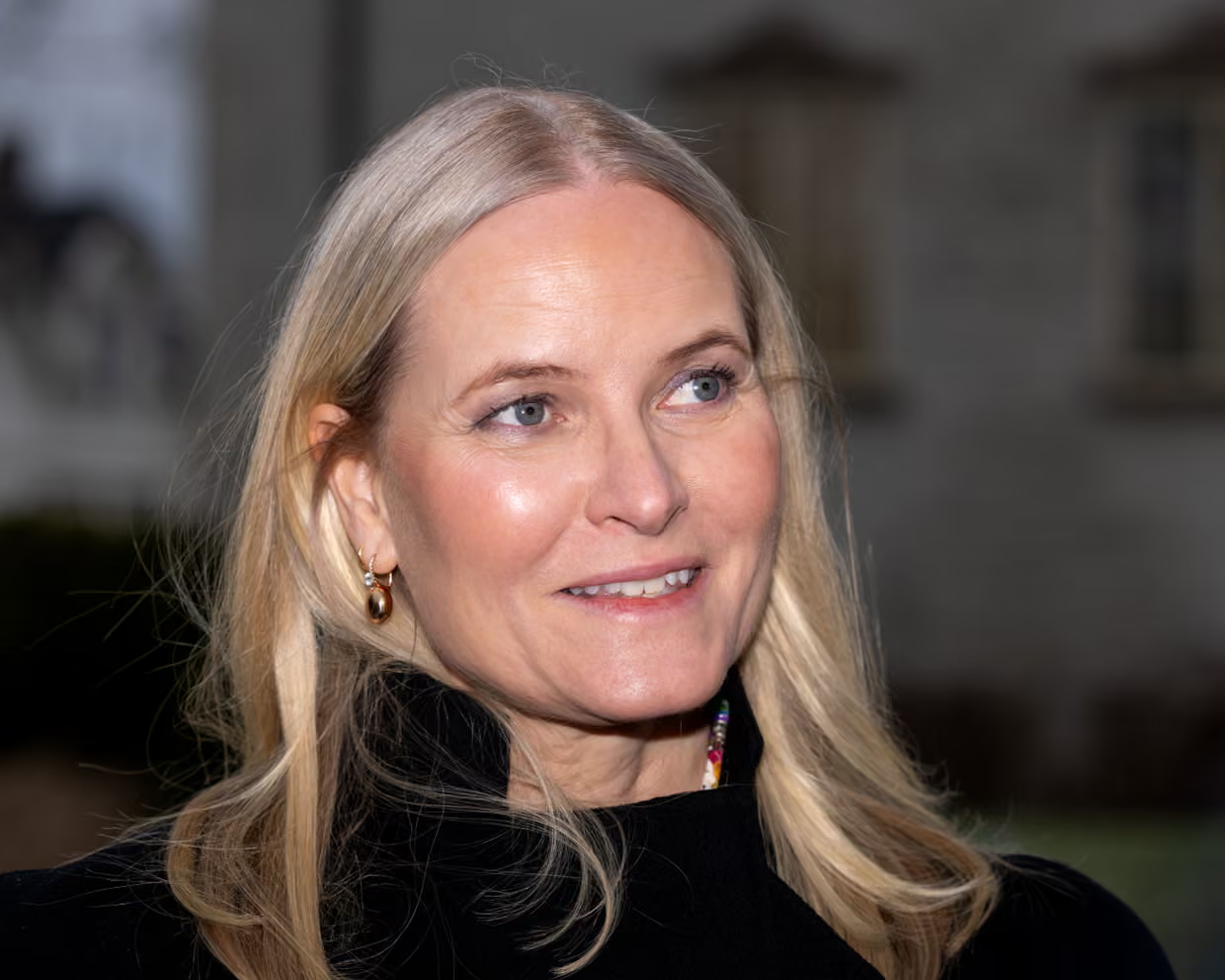
Norway’s Crown Princess Mette-Marit has said she was “manipulated and deceived” by Jeffrey Epstein, speaking publicly for the first time about her long-running association with the disgraced financier.
She insisted she “did not know he was a sex offender or an abuser” — despite having written in a 2011 email, three years after his conviction and 18-month sentence for soliciting sex from girls as young as 14, that she had recently searched for him online.
The release of the Epstein files by the US Justice Department in January has sent shockwaves through Norway, naming several high-profile figures — including Mette-Marit and a former prime minister — in connection with the case.
On Tuesday, Norway’s parliament unanimously approved the creation of an independent investigative commission to examine potential links between Epstein and the country’s foreign office.
According to the documents, Mette-Marit is referenced nearly 1,000 times in email exchanges spanning 2011 to 2014. In one message, she asked whether it was “inappropriate for a mother to suggest two naked women carrying a surfboard for my 15-year-old son’s wallpaper?”
The royal palace had earlier acknowledged that she exercised “poor judgment” and expressed “deep regret at having had any contact with Epstein,” but she had largely avoided public comment until now.
After seven weeks of growing pressure — including calls from Prime Minister Jonas Gahr Støre — she gave a 20-minute interview to Norwegian broadcaster NRK, aired Friday, alongside Crown Prince Haakon at their residence in Skaugum, near Oslo.
The interview was recorded on Thursday, the same day the trial concluded for her son, Marius Borg Høiby, who faces up to seven years in prison if convicted of 39 alleged offences, including four counts of rape, which he denies. Mette-Marit is also battling pulmonary fibrosis and may require a lung transplant.
“I am the mother of a young man who has been in a very demanding situation,” she told NRK. “In addition, I have health that requires a lot of rest. And it has developed even more.”
“It is incredibly important for me to take responsibility for not checking [Epstein’s] background more carefully. And to take responsibility for being so manipulated and deceived as I was,” she said.
She added that she feels “great anger” over the lack of justice for Epstein’s victims, saying: “At the same time, it’s important for me to say if I’ve done something that has contributed to giving him legitimacy in some way.”
Describing their connection, she said Epstein was “a close friend of a good friend of mine” and that they were introduced through mutual contacts in 2011 while she was serving as a special envoy for the UN AIDS Programme.
Their relationship, she maintained, was purely social. “They had a friendly relationship,” she said, emphasizing that he was “a friend of a friend of mine, first and foremost,” and rejecting any suggestion of intimacy.
One of the most scrutinized emails, from October 2011, reads: “Googled you after the previous email. Agreed, it didn’t look good :).”
When asked about it, she said she could not recall what she meant. “I spent a lot of time trying to figure that out myself. I wish I had the rest of that email correspondence,” she said, adding: “But if I had found information that made me realise that he was an abuser and sex offender, I wouldn’t have written a smiley face.”
Asked whether she might have come across a Wikipedia article at the time identifying him as a convicted offender, she responded: “It’s hard for me to say, because I can’t remember. But I didn’t know he was a sex offender or an abuser, if that’s what you’re asking.”
The files also indicate that she stayed at Epstein’s Palm Beach residence in Florida for several days in January 2013. She explained that the visit occurred because “a mutual friend of ours had borrowed the house,” but acknowledged it is something she has reflected on deeply since the full extent of Epstein’s crimes became known in 2019.
Holding back emotion, she said: “The fact that I have been there and, not least, have a sense of guilt for the victims. I have spent a lot of time processing this. So it is very difficult for me personally.”